Children

At Sure Step Podiatry, we are the only podiatry clinic in Coffs Harbour focusing on paediatric patients.
We provide care for children from birth to late adolescence and specialise in addressing structural issues and conditions in infants and toddlers. A few common conditions in newborns and younger children include curved toes, metatarsus adductus, talipes, bowed legs, knock knees, and flat feet. While many of these conditions can resolve without intervention, others may require further treatment. Our children’s podiatrist in Coffs Harbour will provide the specialised assistance each child’s condition requires.
Expert and Caring Children’s Podiatrist in Coffs Harbour
Every child grows and develops differently, so it is essential to be aware of signs that might indicate a problem with their gait. So, if you spot your child exhibiting clumsy walking, tripping, having leg pain, knock-knees or prolonged bowing of the legs, it is important to consult with our certified children’s podiatrist in Coffs Harbour. Even something as small as excessive shoe wear or regular tripping should be assessed if only to give you peace of mind. Our one-hour assessments for children involve various tests designed to monitor movement and strength and look for neurological issues and gait abnormalities. Rest assured, our children’s podiatrist in Coffs Harbour will make young patients comfortable by conducting these assessments through play in a secure and inviting environment.
Our Children’s Podiatry Service
Hypermobility
Hypermobility, or ligamentous laxity, is often seen in children at our clinic. The term hypermobility refers to joint flexibility beyond what the normal joint range of motion should be. Many joints in the body can become extra flexible because the ligaments around the joint that generally support it become more “stretchy”. Hypermobility can allow the joints to get into positions that they shouldn’t usually be in, and this compromised position can lead to subsequent pathologies. Also, aches and pains can present, but there are often no symptoms. The lower limb joints are particularly vulnerable to hypermobility because these are the body’s weight-bearing joints. Talk to our children’s podiatrist in Coffs Harbour today.
Metatarsus
Metatarsus adductus refers to the shape of the foot. There is an inward slanting of the forefoot with a convex lateral border instead of a straight one. There are 3 main types of metatarsus adductus, and the type will indicate the management plan.
Rigid Metatarsus Adductus
Refer for a surgical opinion
Flexible Metatarsus Adductus
Treatment is often not required.
1. The condition typically resolves itself
2. Stretching by parents at home by abducting the forefoot while controlling the rearfoot position
3. Monitor sitting and sleeping positions that accentuate the adducted position
4. Wear shoes with a straight last
Semi-flexible Metatarsus Adductus
Some treatment is recommended to realign the position of the foot. Treatment is normally serial casting or splinting. Or splinting might often be used after casting to hold the foot position after casting has taken place. Once again, parents can monitor sitting and sleeping positions and ensure the child wears a shoe with a straight last.
If you are concerned about your child’s Metatarsus Adductus or are unsure if your child has this deformity, a thorough physical examination by a trained children’s podiatrist in Coffs Harbour is advised. After all, Podiatrists are your foot health experts!
Delayed Development
We often treat children who are a little behind in their developmental stages. Delayed development can be caused by several things, from specific neurological and developmental disorders to fully treatable physical issues resulting in poor gross motor skills coordination. Things to look out for are; tripping, clumsiness, reduced coordination, reduced muscle tone and stiff and jerky gait patterns.
Skin Conditions
Skin complaints seen in children that a children’s podiatrist can treat include:
1. Tineapedis (fungal infection
2. Plantar veruccae (warts)
3. Corns
4. Callous
Sporting Injuries
Kids love sports, but it can be rough out there. Consequently, we treat everything from cuts and bruises to sprains and pulled muscles. In addition to acute injuries, Sure Step Podiatry is proud of its paediatric patient knowledge and can diagnose and manage chronic pain associated with various types of sport. These may include a slow-healing injury due to poor biomechanics or a growth plate abnormality.
Toe Concerns
Digital deformities can be present from birth or appear once the child starts to walk. Common conditions treated concerning toes are; curly toe, overlapping toe, juvenile hallux valgus (or bunion) and hammer toes.
Calcaneal Apophysitis
Calcaneal apophysitis is the inflammation of the growth plate of the calcaneaus or the heel bone. This condition is often seen in active children between the ages of 8 and 15 years and is the most common cause of heel pain in children.
During adolescence, bone growth plates develop in a process where cartilage is replaced by bone. It is understood that due to overuse, sudden increases in activity and rapid growth spurts; this process is disrupted, causing inflammation and pain when walking and running. Often, children at risk for developing this condition present with either flat or high-arched feet, poor-fitting shoes, one leg that may be shorter than the other, or children who play many sports.
Osgood Schlatters Disease
Osgood Schlatters Disease is a condition that often occurs in athletic or active children between the ages of 10 and 15. Generally, this is an overuse knee injury in running and jumping sports. Your child may commonly complain of pain just below the knee cap, with the tenderness worsening after activity or exercise.
Like in Sever’s Disease, another growing pain, this presents as a result of the disturbance during a rapid growth spurt. The growth plate in this condition is an injury due to tension of a tendon of the quadriceps (front thigh muscles) located in a bony area at the top of the tibia (shin) just below the knee.
Walking Difficulties
Many parents become concerned that their child’s gait is abnormal. Although very often, it is age appropriate or corrects itself without help. Moreover, you may be concerned about your child in-toeing and subsequently tripping over. Plus, you may have concerns about your child toe walking or not keeping up with their peers. If you have concerns about how your child walks, contact Sure Step Podiatry for a thorough assessment. We can provide reassurance, treatment, exercises or onward referral.
Children’s Podiatrist in Coffs Harbour – Treatments
Orthotics
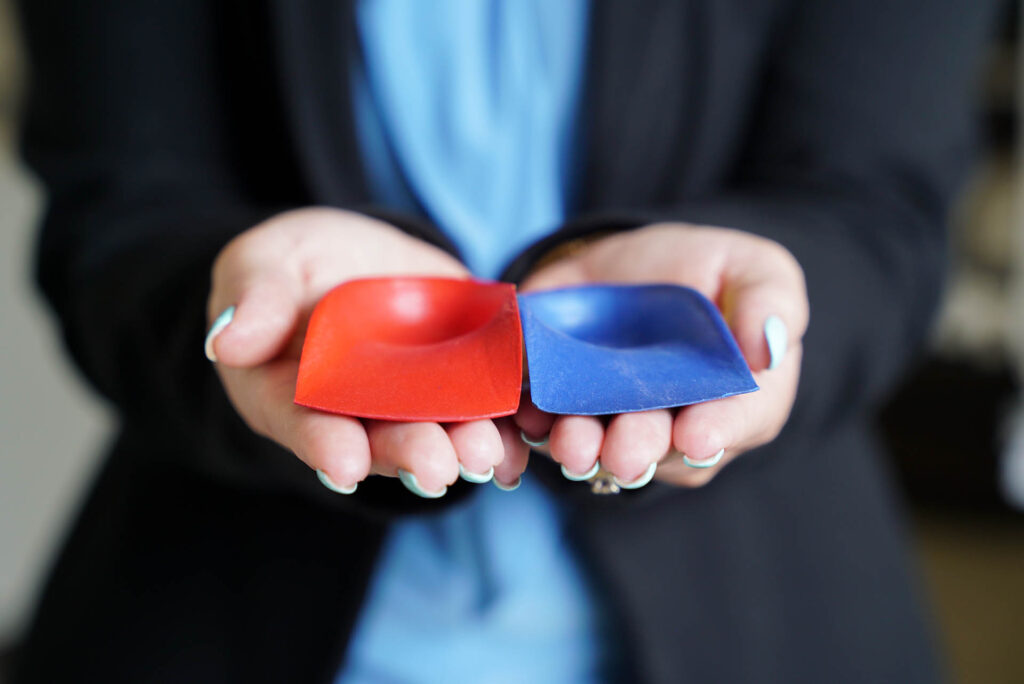
Orthoses – these are specially made devices for your child to wear inside their shoe to control, realign or cushion abnormalities.
Splints/Padding/Strapping
Splints can help realign joints, whilst strapping or padding can be added to the foot or inside the child’s shoe to offload painful areas.
Stretching & Strengthening
Our children’s podiatrist in Coffs Harbour will design a custom set of exercises your child can do to build strength and help stretch problem ligaments and muscles.
Gait Assessment
A detailed gait assessment helps us understand how your child is walking and how that affects the rest of the body. Then, a personally tailored treatment plan would follow.